Generator Starts Then Shuts Off? 7 Common Causes & What to Check
If your generator starts then shuts off, the timing and the message on its controller can help narrow down the cause. A standby generator may start, run briefly, and stop before it can power your home. In other cases, it runs for several minutes before shutting down under load. Those symptoms can point to very different […]
November 11, 2026
If your generator starts then shuts off, the timing and the message on its controller can help narrow down the cause. A standby generator may start, run briefly, and stop before it can power your home. In other cases, it runs for several minutes before shutting down under load. Those symptoms can point to very different problems.
This guide explains seven common causes of a standby generator shutting down, what homeowners can safely observe, and when to schedule professional diagnosis. It covers common residential systems from Generac, Kohler, and Briggs & Stratton. The exact fault names and troubleshooting procedures vary by model.
Safety first: Never bypass a shutdown, remove guards from a running generator, or work inside electrical compartments. Standby generators can start automatically and contain hazardous voltage, hot surfaces, moving parts, and fuel-system components. If you smell gas, move away and contact your gas utility or emergency services from a safe location. Use the manufacturer’s operating instructions for your specific model.
Table of Contents
First, Notice When the Generator Shuts Down
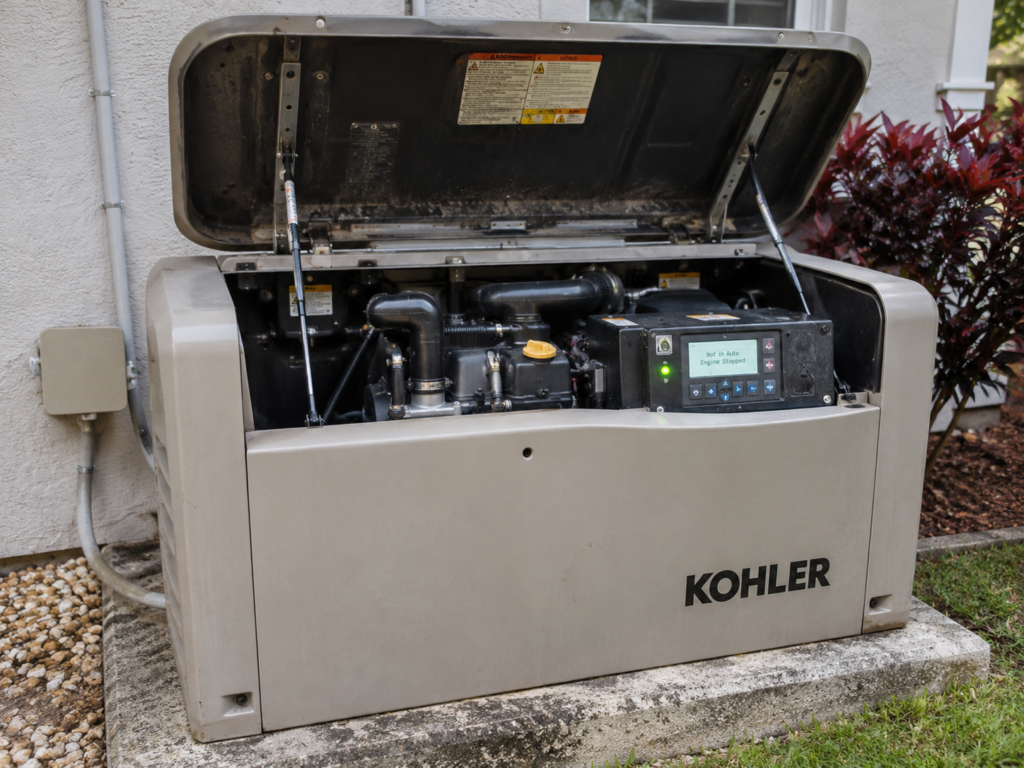
Before resetting anything, note whether the generator shuts off after a few seconds, after warming up, or only when the transfer switch connects the house. Look at the controller display and write down any fault code or warning. If possible, take a photo of the display and record the generator model and serial number.
Also note whether the engine cranks normally, whether it sounds rough or surges, whether the shutdown happens during a weekly exercise or an actual outage, and whether the same problem has happened before. These details are useful to a service technician and can prevent unnecessary parts replacement.
7 Common Reasons a Generator Starts Then Shuts Off
1. Low Oil Pressure or an Oil-Pressure Shutdown
Many standby generators monitor engine oil pressure. If the engine does not develop adequate pressure, the controller may shut it down to protect internal components. Some systems briefly allow the engine to start before evaluating oil pressure, which can make the generator appear to start normally and then stop.
A low oil level, incorrect oil viscosity, an oil-pressure switch or sensor problem, wiring trouble, or an actual lubrication issue can contribute. A low oil-pressure warning does not prove that the sensor is defective, and adding oil is not always the solution.
Safe homeowner check: With the generator off and cooled, follow the owner’s manual to check the dipstick on models equipped with one. Do not overfill. If the oil level is correct but the low-pressure fault returns, leave the generator off and arrange service. A technician may need to verify actual oil pressure with appropriate equipment.
2. Fuel Supply or Fuel-Pressure Problems
Natural-gas and propane standby generators depend on a consistent fuel supply. An engine may start on the fuel initially available and then stall if pressure or flow cannot keep up. Problems can become more obvious when the engine accelerates or the generator begins carrying electrical load.
Potential causes include inadequate supply pressure, an improperly sized fuel line, a regulator issue, a closed valve, an empty or low propane tank, or restrictions in the fuel system. Fuel demand is different at idle, exercise, and full load, so a system that runs unloaded may still fail during an outage.
Safe homeowner check: If you use propane, check the tank level from its normal external gauge. Note whether other gas appliances are operating normally. Do not loosen gas fittings, adjust regulators, or attempt fuel-pressure testing. A qualified technician should measure pressure under the conditions specified by the manufacturer.
3. Battery, Charging, or Electrical Connection Issues
The starting battery does more than crank the engine on many standby systems. Controllers, fuel-control devices, and other electrical components may depend on stable DC voltage. A weak battery, loose connection, charging-system fault, or corroded terminal can cause erratic operation or contribute to a shutdown.
A generator that cranks strongly is not automatically free of battery or charging problems. The voltage may drop at a critical moment, or a poor connection may become intermittent as the engine vibrates. Some faults will be logged by the controller; others require electrical testing.
Safe homeowner check: Look for visible corrosion or a battery warning without touching energized components. Record the battery’s approximate age if known. Do not disconnect the battery while the generator is running or attempt to bypass a battery or charging fault.
4. Engine Speed, Frequency, or Overspeed Faults
Standby generators must maintain the engine speed and electrical frequency required by their design. If the engine runs too fast, too slowly, or becomes unstable, the controller may shut it down. Depending on the model, the display might show an overspeed, underspeed, underfrequency, or related fault.
Possible contributors include fuel-delivery issues, governor or throttle-control problems, engine sensors, ignition problems, or a sudden load change. A surging engine that speeds up and slows down repeatedly is an important symptom to report.
Safe homeowner check: Record the exact fault message and whether the engine sounded unusually fast or uneven. Avoid adjusting throttle linkages, governor settings, or controller parameters. These are model-specific service procedures, and incorrect adjustments can create unsafe operating conditions.
5. Overload, Short Circuit, or a Problem When the Load Transfers
One of the most useful clues is whether the generator runs during its exercise cycle but shuts down when it is asked to power the home. The generator may be reacting to an overload, an electrical fault, or an issue involving the automatic transfer switch (ATS) or connected circuits.
Large air conditioners, pumps, electric heating equipment, and other motor loads can demand significant starting current. A load-management system may be required on some installations. However, a shutdown during transfer can also involve a generator output issue or a transfer-switch fault, so the timing alone does not establish the cause.
Safe homeowner check: Note whether the shutdown occurred immediately after utility power failed or after a major appliance started. Do not open the transfer switch, remove electrical covers, or manipulate breakers in an attempt to defeat protective controls. A technician can evaluate the electrical load and transfer sequence safely.
6. Overheating or Restricted Cooling Airflow
Generators produce substantial heat. Blocked intake or exhaust openings, debris around the enclosure, damaged cooling components, or an engine-cooling problem can trigger a high-temperature shutdown. Liquid-cooled generators can have additional issues involving coolant level, circulation, hoses, belts, or temperature sensors.
Overheating may not occur immediately. A generator might run for several minutes and then stop as temperatures rise. Hot weather and prolonged outage operation can make cooling problems more noticeable, especially in South Florida.
Safe homeowner check: Once the unit is off and cool, visually inspect the area around the enclosure for leaves, landscaping, or other obstructions. Keep required clearances in accordance with the installation manual. Do not open a hot radiator cap, reach into a running enclosure, or continue restarting a generator that reports a high-temperature fault.
7. Ignition, Sensor, Controller, or Wiring Faults
Some generators shut down because a sensor signal is missing, the ignition system becomes unreliable, a wiring connection is intermittent, or the controller detects a condition it cannot safely ignore. Faults may involve engine position or speed sensing, ignition components, control relays, harness connections, or other model-specific devices.
A controller code is a starting point for diagnosis, not a guaranteed instruction to replace a particular part. For example, a speed-related code may be caused by a sensor, its wiring, fuel delivery, or an actual engine-speed problem. Replacing parts without testing can increase repair costs without resolving the shutdown.
Safe homeowner check: Photograph the displayed code, note whether it returns after an authorized reset, and avoid repeated restart attempts. A professional can review fault history, verify power and ground circuits, and test components according to the manufacturer’s service information.
What the Shutdown Timing Can Tell You
- Stops within seconds: Look for a controller fault involving oil pressure, speed sensing, ignition, or an immediate protective shutdown.
- Runs briefly, then sputters and stops: Fuel delivery or unstable engine operation may be involved.
- Runs until the house transfers to generator power: The electrical load, transfer sequence, or output protection deserves attention.
- Runs for several minutes before stopping: Temperature, fuel flow under sustained demand, or a developing operating fault may be involved.
- Only fails during an outage: Compare what happens under load with the normal weekly exercise cycle; many exercise cycles do not transfer the house load.
These patterns are clues, not definitive diagnoses. Different models may behave differently, and the recorded fault code and test results matter more than timing alone.
Should You Reset a Generator That Keeps Shutting Down?
Some generators permit an owner to acknowledge a fault and perform a reset using the procedure in the owner’s manual. However, a reset does not repair the underlying cause. If the unit repeatedly shuts down, displays a serious protective fault, leaks fluid, smells of fuel, or makes an unusual mechanical noise, do not keep attempting to run it.
Repeated resets can erase useful fault information on some systems or allow additional damage if a mechanical or lubrication problem is present. Write down the code first. If you are uncertain about the message or procedure, schedule service rather than guessing.
When to Call a Professional Generator Technician
If your generator starts then shuts off repeatedly, professional diagnosis is appropriate, particularly if the failure happens during an outage or when the transfer switch engages. A qualified technician can examine controller history, check fuel pressure under load, verify battery and charging performance, inspect cooling and engine systems, and evaluate generator output and ATS operation.
At Treasure Coast Generators, we service residential and commercial standby generators, including Generac, Kohler, and Briggs & Stratton equipment. Our diagnostic approach focuses on identifying the cause before recommending repairs. Learn more about our generator repair services.
We serve homeowners and businesses across Martin, St. Lucie, Indian River, Okeechobee, and northern Palm Beach counties, including Stuart, Palm City, Port St. Lucie, Fort Pierce, Vero Beach, Jupiter, and nearby communities. To schedule a diagnostic visit, call 772-882-6520.
Frequently Asked Questions
Why does my Generac generator start and then shut off?
A Generac standby generator may shut down because of an oil-pressure fault, fuel problem, speed or frequency issue, temperature condition, or another controller-detected fault. Record the exact display message and model number before requesting service.
Why does my generator run during exercise but stop during an outage?
Exercise often occurs without transferring the home’s electrical load. A problem that appears only during an outage may involve load demand, fuel flow under load, transfer-switch operation, or generator output protection.
Can low propane cause a generator to shut down after starting?
Yes. Low propane supply or inadequate fuel pressure can prevent an engine from continuing to run, especially when demand increases. A qualified technician should verify pressure and flow; homeowners should not adjust gas regulators.
Will changing the battery fix a generator that shuts off?
Only if the battery or related DC electrical system is contributing to the problem. A battery replacement will not correct an oil-pressure, fuel-pressure, overheating, or transfer-related fault. Testing should determine the cause.
Is it safe to keep resetting the generator?
No, not if the shutdown repeats or a protective fault remains active. Record the message and follow the owner’s manual. Repeatedly overriding or clearing a serious shutdown can risk equipment damage.
Get Help Before the Next Power Outage
A standby generator that starts but cannot stay running may leave your home without backup power when you need it most. Document the symptoms, avoid unsafe troubleshooting, and have the system evaluated before the next storm. For generator diagnostics and repair on Florida’s Treasure Coast, contact Treasure Coast Generators at 772-882-6520.
For manufacturer-specific operating guidance, consult the owner’s manual for your exact generator model or visit the Generac Support Center if you own Generac equipment.
Ready to Schedule Generator Service?
Call us today or request a quote online. We serve Martin, St. Lucie, Palm Beach, Indian River, and Okeechobee Counties.
We return calls the same business day, Mon–Fri 8–5.